
| Size of file | : 2.94MB |
| Department | : Social sciences |
| Language | : Italian |
| Date of Coming | : 2022-08-10 |
| book quality | : Excellent |
| Number of Pages | : 232 |
| Auther | : Arthur Schopenhauer |
| Section | : Philosophy and logic |
Author: Arthur Schopenhauer
About the Author: Arthur Schopenhauer is a German philosopher, usually famous for his pessimism about life as “a pendulum that swings between pain and boredom.” Schopenhauer actually lived alone and immersed for the greater part of his life, but his loneliness or personal suffering was not, as some think, a primary reason for formulating his pessimistic views of life. On the contrary, Schopenhauer’s life – at least in its beginning – was not as bad as we might imagine, and it can be said that many opportunities were available to him to live a quiet academic and bourgeois life that satisfies the masses of people. of modern and ancient languages, as he went to dance and theater parties in his youth, His mother Joanna also set up a salon attended by many intellectuals, including the great German poet Goethe, but Arthur was constantly at odds with his mother, especially after his father’s death. Schopenhauer later obtained his doctorate from the University of Berlin, and he was destined to have a quiet teaching career had he not chosen – stubbornly, courageous and perhaps naive – to give his lectures at the same time during which the most prominent German philosopher at the time, Georg Hegel, was giving his lectures, no one listened to Schopenhauer Who decided to retire from teaching and devote himself to writing. Schopenhauer offered his extremely insightful views on many issues, from epistemology and philosophy of science to philosophy of ethics and art, and he was careful in his thinking, following the example of the German philosopher Kant the “Great” as he liked to describe him, particularly in his strict self-criticism of his ideas. He also remained loyal to philosophy, resenting those who make it an “instrument of state purposes from above, and personal purposes from below”. And he was firm in his conviction that he had accomplished his philosophical work not for his contemporaries or for the people of his country, but for humanity, because of his belief that everything of value needed a long time to gain its legitimacy. of moral authority) even daring to describe the latter as a “charlatan” and “mentally degenerate.”
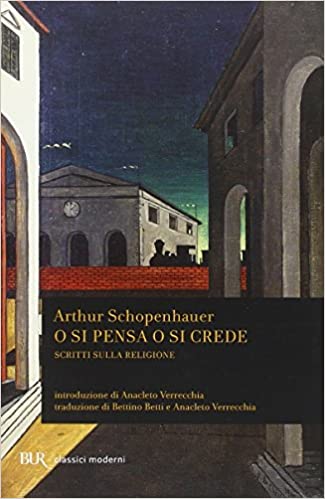
O si pensa o si crede:Scritti sulla religione book pdf download By Arthur Schopenhauer
Di solito sono gli dèi che fulminano gli uomini. In questa raccolta di scritti, invece, abbiamo un filosofo che fulmina gli dèi, al plurale come al singolare. E non è detto che le sue saette siano meno micidiali di quelle celesti. Eccone qualcuna: “Se un dio ha fatto questo mondo, io non vorrei essere quel dio, perché il dolore del mondo mi strazierebbe il cuore”. Oppure: “Quando uno comincia a parlare di Dio, io non so di che cosa parli”. Infatti “le religioni, tutte, sono prodotti artificiali”. Se Nietzsche, con l’enfasi abituale, proclama la morte di Dio, Schopenhauer, ora con il suo sarcasmo ora con la sua logica implacabile, quel dio lo uccide davvero, togliendo qualsiasi validità teoretica al teismo.
Download PDF of O si pensa o si crede:Scritti sulla religione book pdf download By Arthur Schopenhauer
-Adrian Agency Library

No comment yet, add your voice below!