
| Date of Coming | : 2022-08-10 |
| book quality | : Good |
| Section | : Geography |
| Number of Pages | : 512 |
| Language | : English |
| Auther | : Michael Goodchild |
| Size of file | : 40.5MB |
| Department | : Social sciences |
Author: Michael Goodchild
About the Author: Michael F. Goodchild is Professor of Geography at the University of California, Santa Barbara; Chair of the Executive Committee, National Center for Geographic Information and Analysis (NCGIA); Associate Director of the Alexandria Digital Library Project; and Director of NCGIA’s Center for Spatially Integrated Social Science. He received his BA degree from Cambridge University in Physics in 1965 and his PhD in Geography from McMaster University in 1969. After 19 years at the University of Western Ontario, he moved to Santa Barbara in 1988. He was Director of NCGIA from 1991 to 1997. He was elected member of the National Academy of Sciences and Foreign Fellow of the Royal Society of Canada in 2002, and member of the American Academy of Arts and Sciences in 2006. He has received honorary doctorates from Laval University (1999), Keele University (2001), McMaster University (2004), and Ryerson University (2004). In 1990 he was given the Canadian Association of Geographers Award for Scholarly Distinction, in 1996 the Association of American Geographers award for Outstanding Scholarship, in 1999 the Canadian Cartographic Association’s Award of Distinction for Exceptional Contributions to Cartography, and in 2002 the Educator of the Year Award from the University Consortium for Geographic Information Science. In 2001 he received a Lifetime Achievement Award from Environmental Systems Research Institute, Inc. He was Editor of Geographical Analysis between 1987 and 1990 and Editor of the Methods, Models, and Geographic Information Sciences section of the Annals of the Association of Americal Geographers from 2000 to 2006. He serves on the editorial boards of ten other journals and book series. His major publications include Accuracy of Spatial Databases (1989); Geographical Information Systems: Principles and Applications (1991); Environmental Modeling with GIS (1993); GIS and Environmental Modeling: Progress and Research Issues (1996); Scale in Remote Sensing and GIS (1997); Interoperating Geographic Information Systems (1999); Geographical Information Systems: Principles, Techniques, Management and Applications (1999); Geographic Information Systems and Science (2001 and 2005); Spatial Uncertainty in Ecology (2001); Spatial Data Quality (2002); Uncertainty in Geographical Information (2002); Foundations of Geographic Information Science (2003); Spatially Integrated Social Science (2004); and GIS, Spatial Analysis, and Modeling (2005); in addition he is author of some 350 scientific papers. He was Chair of the National Research Council’s Mapping Science Committee from 1997 to 1999; and is currently a member of NRC’s Geographic Science Committee. His current research interests center on geographic information science, spatial analysis, and uncertainty in geographic data.
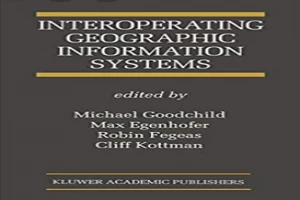
Interoperating Geographic Information Systems book pdf download By Michael Goodchild
Geographic information systems have developed rapidly in the past decade, and are now a major class of software, with applications that include infrastructure maintenance, resource management, agriculture, Earth science, and planning. But a lack of standards has led to a general inability for one GIS to interoperate with another. It is difficult for one GIS to share data with another, or for people trained on one system to adapt easily to the commands and user interface of another. Failure to interoperate is a problem at many levels, ranging from the purely technical to the semantic and the institutional. Interoperating Geographic Information Systems is about efforts to improve the ability of GISs to interoperate, and has been assembled through a collaboration between academic researchers and the software vendor community under the auspices of the US National Center for Geographic Information and Analysis and the Open GIS Consortium Inc. It includes chapters on the basic principles and the various conceptual frameworks that the research community has developed to think about the problem. Other chapters review a wide range of applications and the experiences of the authors in trying to achieve interoperability at a practical level. Interoperability opens enormous potential for new ways of using GIS and new mechanisms for exchanging data, and these are covered in chapters on information marketplaces, with special reference to geographic information. Institutional arrangements are also likely to be profoundly affected by the trend towards interoperable systems, and nowhere is the impact of interoperability more likely to cause fundamental change than in education, as educators address the needs of a new generation of GIS users with access to a new generation of tools. The book concludes with a series of chapters on education and institutional change. Interoperating Geographic Information Systems is suitable as a secondary text for graduate level courses in computer science, geography, spatial databases, and interoperability and as a reference for researchers and practitioners in industry, commerce and government.
Download PDF of Interoperating Geographic Information Systems book pdf download By Michael Goodchild
-Adrian Agency Library

No comment yet, add your voice below!