| Section |
: Sociology |
| Language |
: English |
| Number of Pages |
: 50 |
| book quality |
: Good |
| Date of Coming |
: 2022-08-10 |
| Department |
: Social sciences |
| Size of file |
: 11.5MB |
| Auther |
: Jennifer Robertson |
Author: Jennifer Robertson
About the Author: Jennifer Robertson is Professor Emeritus (as of January 2020), Department of Anthropology and Art History, and Penny W. College of Art and Design at the University of Michigan, Ann Arbor. She is also an associate professor in the Departments of Anthropology and Japanese Studies, University of Washington, Seattle. Robertson received her Ph.D. in Anthropology from Cornell University in 1985, where she also received her BA. in Art History in 1975. She has been an Invited Fellow at Wissenschaftskolleg zu Berlin (1996-1997) and an Invited Fellow at the John Simon Guggenheim Memorial Foundation (2011-2012). ACLS, SSRC, NEH, Japan Foundation, Abé Foundation, Wenner Gren, and Fulbright are among her other fellowships. Robertson is the creator and general editor of COLONIALISMS, a book series (now closed) from University of California Press. Books in the series explore the historical realities, current significance, and future ramifications of imperial practices with origins and borders outside the “West”. Previously she worked as editor of Critical Asian Studies in Japan and is now a member of the editorial board (http://criticalasianstudies.org). Her seven books and more than eighty articles and chapters cover a wide range of topics ranging from the seventeenth century to the present, including social reform movements and religion, agrarianism, systems and ideologies of gender and sexuality, mass and popular culture, nostalgia and globalization, Japan’s place in anthropology , sex and suicide, theater and performance, votive and folk arts, imperialism and colonialism, eugenics and bioethics, technology and robotics. Her publications have been translated into German, Finnish, French, Hebrew, Japanese and Spanish. She taught graduate and undergraduate courses in anthropological history, theories, and methods; Non-Western Colonies; Art, Identity, and Anthropology; Bio art. photo-based ethnography-robot interaction of mass and popular cultures; Ethnic diversity in Japan; gender, gender and gender; Japanese culture and society, among other topics. Robertson is currently researching, writing and editing articles on the cultural history of Japanese eugenics. art, science and technology; sex and gender systems; Human-robot interfaces in Japan and elsewhere; and biomimetics. Her most recent book is Robo sapiens japanicus: Robots, Gender, Family and the Nation (University of California Press, 2018); Japanese edition is coming. Although her primary specialty is Japan, where she has lived for over two decades, Robertson has also worked in Sri Lanka (1982-1992) and since 1997 has also been working in Israel. In addition to her academic work, she makes collages, watercolors, serigraphs, ceramics, and oil paintings.
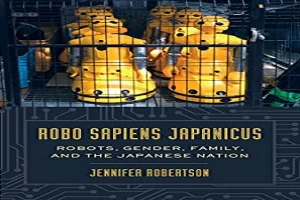
Robo sapiens japanicus: Robots, Gender, Family, and the Japanese Nation book pdf download By Jennifer Robertson
Japan is arguably the first postindustrial society to embrace the prospect of human-robot coexistence. Over the past decade, Japanese humanoid robots designed for use in homes, hospitals, offices, and schools have become celebrated in mass and social media throughout the world. In Robo sapiens japanicus, Jennifer Robertson casts a critical eye on press releases and public relations videos that misrepresent robots as being as versatile and agile as their science fiction counterparts. An ethnography and sociocultural history of governmental and academic discourse of human-robot relations in Japan, this book explores how actual robots—humanoids, androids, and animaloids—are “imagineered” in ways that reinforce the conventional sex/gender system and political-economic status quo. In addition, Robertson interrogates the notion of human exceptionalism as she considers whether “civil rights” should be granted to robots. Similarly, she juxtaposes how robots and robotic exoskeletons reinforce a conception of the “normal” body with a deconstruction of the much-invoked Theory of the Uncanny Valley.
Download PDF of Robo sapiens japanicus: Robots, Gender, Family, and the Japanese Nation book pdf download By Jennifer Robertson
-Adrian Agency Library