
| Section | : Economy |
| Auther | : Vaclav Smil |
| Language | : English |
| Size of file | : 28.0MB |
| Number of Pages | : 0 |
| Date of Coming | : 2022-09-14 |
| book quality | : Excellent |
| Department | : Social sciences |
Author: Vaclav Smil
About the Author: Vaclav Smil is currently a Distinguished Professor in the Faculty of Environment at the University of Manitoba in Winnipeg, Canada. He completed his graduate studies at the Faculty of Natural Sciences of Carolinum University in Prague and at the College of Earth and Mineral Sciences of the Pennsylvania State University. His interdisciplinary research interests encompass a broad area of energy, environmental, food, population, economic, historical and public policy studies, and he had also applied these approaches to energy, food and environmental affairs of China.
About the Author: He is a Fellow of the Royal Society of Canada (Science Academy) and the first non-American to receive the American Association for the Advancement of Science Award for Public Understanding of Science and Technology. He has been an invited speaker in more than 250 conferences and workshops in the USA, Canada, Europe, Asia and Africa, has lectured at many universities in North America, Europe and East Asia and has worked as a consultant for many US, EU and international institutions. His wife Eva is a physician and his son David is an organic synthetic chemist.
Japan’s Dietary Transition and Its Impacts book pdf download By Vaclav Smil
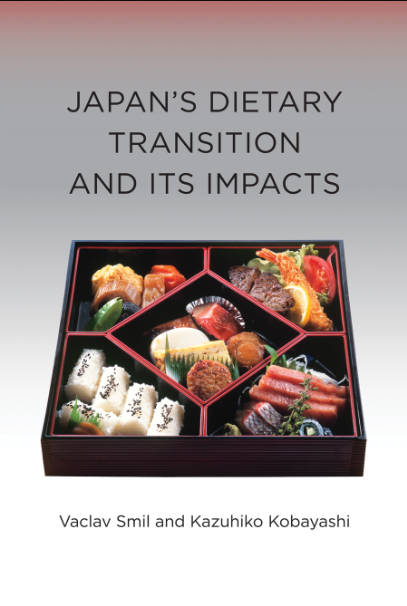
In a little more than a century, the Japanese diet has undergone a dramatic transformation. In 1900, a plant-based, near-subsistence diet was prevalent, with virtually no consumption of animal protein. By the beginning of the twenty-first century, Japan’s consumption of meat, fish, and dairy had increased markedly (although it remained below that of high-income Western countries). This dietary transition was a key aspect of the modernization that made Japan the world’s second largest economic power by the end of the twentieth century, and it has helped Japan achieve an enviable demographic primacy, with the world’s highest life expectancy and a population that is generally healthier (and thinner) than that of other modern affluent countries. In this book, Vaclav Smil and Kazuhiko Kobayashi examine Japan’s gradual but profound dietary change and investigate its consequences for health, longevity, and the environment. Smil and Kobayashi point out that the gains in the quality of Japan’s diet have exacted a price in terms of land use changes, water requirements, and marine resource depletion; and because Japan imports so much of its food, this price is paid globally as well as domestically. The book’s systematic analysis of these diverse consequences offers the most detailed account of Japan’s dietary transition available in English.
Download PDF of Japan’s Dietary Transition and Its Impacts book pdf download By Vaclav Smil
-Adrian Agency Library

No comment yet, add your voice below!