Invisible: The Dangerous Allure of the Unseen book pdf download

Size of file : 1.93MB
Auther : Philip Ball
Section : classical physics
Number of Pages : 333
book quality : Excellent
Date of Coming : 2022-08-10
Department : Natural Science
Language : English

Author: Philip Ball

About the Author: Philip Ball is a freelance science writer. He worked previously at Nature for over 20 years, first as an editor for physical sciences (for which his brief extended from biochemistry to quantum physics and materials science) and then as a Consultant Editor. His writings on science for the popular press have covered topical issues ranging from cosmology to the future of molecular biology. Philip is the author of many popular books on science, including works on the nature of water, pattern formation in the natural world, colour in art, the science of social and political philosophy, the cognition of music, and physics in Nazi Germany. He has written widely on the interactions between art and science, and has delivered lectures to scientific and general audiences at venues ranging from the Victoria and Albert Museum (London) to the NASA Ames Research Center, London’s National Theatre and the London School of Economics. Philip continues to write regularly for Nature. He has contributed to publications ranging from New Scientist to the New York Times, the Guardian, the Financial Times and New Statesman. He is a contributing editor of Prospect magazine (for which he writes a science blog), and also a columnist for Chemistry World, Nature Materials, and the Italian science magazine Sapere. He has broadcast on many occasions on radio and TV, and is a presenter of “Science Stories” on BBC Radio 4. He is a Fellow of the Royal Society of Chemistry, sits on the editorial board of Chemistry World and Interdiscipinary Science Reviews, and is a board member of the RESOLV network on solvation science at the Ruhr University of Bochum. Philip has a BA in Chemistry from the University of Oxford and a PhD in Physics from the University of Bristol. Philip Ball is a writer. Most of his books are concerned with science in some form or another: its history, its interactions with the arts and society, its achievements, delights and detours. He is a regular columnist for several magazines and an occasional radio presenter and broadcaster. He was an editor of Nature for many years, and long ago, a chemist and physicist of sorts.

Invisible: The Dangerous Allure of the Unseen book pdf download By Philip Ball

If offered the chance—by cloak, spell, or superpower—to be invisible, who wouldn’t want to give it a try? We are drawn to the idea of stealthy voyeurism and the ability to conceal our own acts, but as desirable as it may seem, invisibility is also dangerous. It is not just an optical phenomenon, but a condition full of ethical questions. As esteemed science writer Philip Ball reveals in this book, the story of invisibility is not so much a matter of how it might be achieved but of why we want it and what we would do with it. In this lively look at a timeless idea, Ball provides the first comprehensive history of our fascination with the unseen. This sweeping narrative moves from medieval spell books to the latest nanotechnology, from fairy tales to telecommunications, from camouflage to ghosts to the dawn of nuclear physics and the discovery of dark energy. Along the way, Invisible tells little-known stories about medieval priests who blamed their misdeeds on spirits; the Cock Lane ghost, which intrigued both Samuel Johnson and Charles Dickens; the attempts by Victorian scientist William Crookes to detect psychic forces using tiny windmills; novelist Edward Bulwer-Lytton’s belief that he was unseen when in his dressing gown; and military efforts to enlist magicians to hide tanks and ships during WWII. Bringing in such voices as Plato and Shakespeare, Ball provides not only a scientific history but a cultural one—showing how our simultaneous desire for and suspicion of the invisible has fueled invention and the imagination for centuries. In this unusual and clever book, Ball shows that our fantasies about being unseen—and seeing the unseen—reveal surprising truths about who we are.

Download PDF of Invisible: The Dangerous Allure of the Unseen book pdf download By Philip Ball
-Adrian Agency Library

Download Now

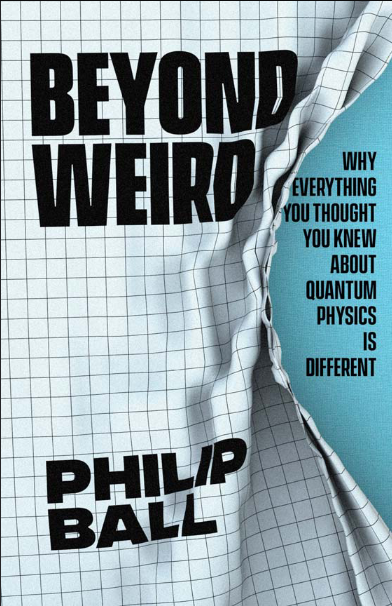
Beyond Weird book pdf download

Section : classical physics
Language : English
Auther : Philip Ball
Date of Coming : 2022-08-10
Size of file : 1.77MB
Number of Pages : 382
book quality : Excellent
Department : Natural Science

Author: Philip Ball

About the Author: Philip Ball is a freelance science writer. He worked previously at Nature for over 20 years, first as an editor for physical sciences (for which his brief extended from biochemistry to quantum physics and materials science) and then as a Consultant Editor. His writings on science for the popular press have covered topical issues ranging from cosmology to the future of molecular biology. Philip is the author of many popular books on science, including works on the nature of water, pattern formation in the natural world, colour in art, the science of social and political philosophy, the cognition of music, and physics in Nazi Germany. He has written widely on the interactions between art and science, and has delivered lectures to scientific and general audiences at venues ranging from the Victoria and Albert Museum (London) to the NASA Ames Research Center, London’s National Theatre and the London School of Economics. Philip continues to write regularly for Nature. He has contributed to publications ranging from New Scientist to the New York Times, the Guardian, the Financial Times and New Statesman. He is a contributing editor of Prospect magazine (for which he writes a science blog), and also a columnist for Chemistry World, Nature Materials, and the Italian science magazine Sapere. He has broadcast on many occasions on radio and TV, and is a presenter of “Science Stories” on BBC Radio 4. He is a Fellow of the Royal Society of Chemistry, sits on the editorial board of Chemistry World and Interdiscipinary Science Reviews, and is a board member of the RESOLV network on solvation science at the Ruhr University of Bochum. Philip has a BA in Chemistry from the University of Oxford and a PhD in Physics from the University of Bristol. Philip Ball is a writer. Most of his books are concerned with science in some form or another: its history, its interactions with the arts and society, its achievements, delights and detours. He is a regular columnist for several magazines and an occasional radio presenter and broadcaster. He was an editor of Nature for many years, and long ago, a chemist and physicist of sorts.

Beyond Weird book pdf download By Philip Ball

Beyond Weird: Why Everything You Thought You Knew about Quantum Physics Is Different. “Anyone who is not shocked by quantum theory has not understood it.” Since Niels Bohr said this many years ago, quantum mechanics has only been getting more shocking. We now realize that it’s not really telling us that “weird” things happen out of sight, on the tiniest level, in the atomic world. Rather, we can now see that everything is quantum: our everyday world is simply what quantum becomes at the human scale. But if quantum mechanics is right, what seems obvious and right in our everyday world is built on foundations that don’t seems obvious or right—or even possible. An exhilarating tour of the contemporary quantum landscape,Beyond Weirdis a book about what quantum physics really means—and what it doesn’t. Science writer Philip Ball offers an up-to-date, accessible account of the quest to come to grips with the most fundamental theory of physical reality, and to explain how its counterintuitive principles underpin the world we experience. Over the past decade it has become clear that quantum physics is less a theory about particles and waves, uncertainty and fuzziness, than a theory about information and knowledge—about what can be known, and how we know it. Discoveries and experiments over the past few decades have called into question the meanings and limits of space and time, cause and effect, and, ultimately, of knowledge itself. The quantum world Ball shows us isn’t a different world. It is our world, and if anything deserves to be called “weird,” it’s us.

Download PDF of Beyond Weird book pdf download By Philip Ball
-Adrian Agency Library
Download Now

Critical Mass: How One Thing Leads to Another book pdf download

book quality : Excellent
Language : English
Auther : Philip Ball
Size of file : 5.51MB
Section : classical physics
Department : Natural Science
Date of Coming : 2022-08-10
Number of Pages : 621

Author: Philip Ball

About the Author: Philip Ball is a freelance science writer. He worked previously at Nature for over 20 years, first as an editor for physical sciences (for which his brief extended from biochemistry to quantum physics and materials science) and then as a Consultant Editor. His writings on science for the popular press have covered topical issues ranging from cosmology to the future of molecular biology. Philip is the author of many popular books on science, including works on the nature of water, pattern formation in the natural world, colour in art, the science of social and political philosophy, the cognition of music, and physics in Nazi Germany. He has written widely on the interactions between art and science, and has delivered lectures to scientific and general audiences at venues ranging from the Victoria and Albert Museum (London) to the NASA Ames Research Center, London’s National Theatre and the London School of Economics. Philip continues to write regularly for Nature. He has contributed to publications ranging from New Scientist to the New York Times, the Guardian, the Financial Times and New Statesman. He is a contributing editor of Prospect magazine (for which he writes a science blog), and also a columnist for Chemistry World, Nature Materials, and the Italian science magazine Sapere. He has broadcast on many occasions on radio and TV, and is a presenter of “Science Stories” on BBC Radio 4. He is a Fellow of the Royal Society of Chemistry, sits on the editorial board of Chemistry World and Interdiscipinary Science Reviews, and is a board member of the RESOLV network on solvation science at the Ruhr University of Bochum. Philip has a BA in Chemistry from the University of Oxford and a PhD in Physics from the University of Bristol. Philip Ball is a writer. Most of his books are concerned with science in some form or another: its history, its interactions with the arts and society, its achievements, delights and detours. He is a regular columnist for several magazines and an occasional radio presenter and broadcaster. He was an editor of Nature for many years, and long ago, a chemist and physicist of sorts.

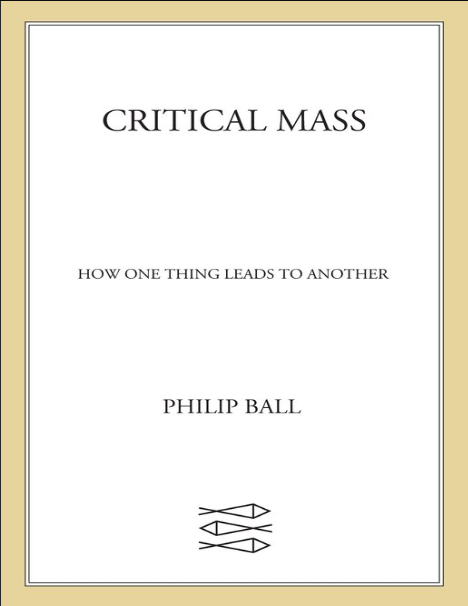
Critical Mass: How One Thing Leads to Another book pdf download By Philip Ball

Are there any “laws of nature” that influence the ways in which humans behave and organize themselves? In the seventeenth century, tired of the civil war ravaging England, Thomas Hobbes decided that he would work out what kind of government was needed for a stable society. His approach was based not on utopian wishful thinking but rather on Galileo’s mechanics to construct a theory of government from first principles. His solution is unappealing to today’s society, yet Hobbes had sparked a new way of thinking about human behavior in looking for the “scientific” rules of society. Adam Smith, Immanuel Kant, Auguste Comte, and John Stuart Mill pursued this idea from different political perspectives. Little by little, however, social and political philosophy abandoned a “scientific” approach. Today, physics is enjoying a revival in the social, political and economic sciences. Ball shows how much we can understand of human behavior when we cease to try to predict and analyze the behavior of individuals and instead look to the impact of individual decisions-whether in circumstances of cooperation or conflict-can have on our laws, institutions and customs. Lively and compelling, Critical Mass is the first book to bring these new ideas together and to show how they fit within the broader historical context of a rational search for better ways to live.

Download PDF of Critical Mass: How One Thing Leads to Another book pdf download By Philip Ball
-Adrian Agency Library

Download Now

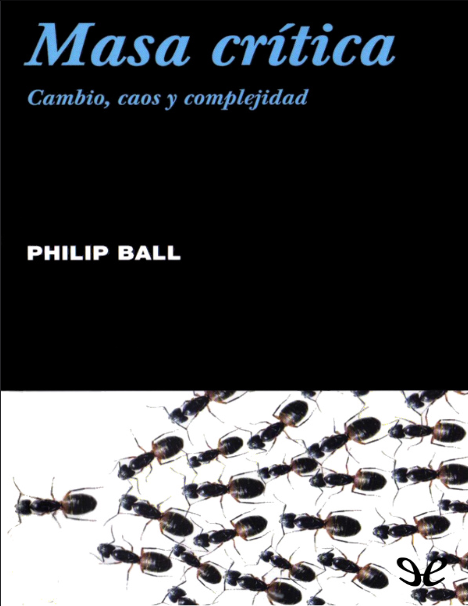
Masa crítica: cambio, caos y complejidad book pdf download

Language : Spanish
book quality : Excellent
Size of file : 5.63MB
Auther : Philip Ball
Number of Pages : 1088
Department : Natural Science
Section : classical physics
Date of Coming : 2022-08-10

Author: Philip Ball

About the Author: Philip Ball is a freelance science writer. He worked previously at Nature for over 20 years, first as an editor for physical sciences (for which his brief extended from biochemistry to quantum physics and materials science) and then as a Consultant Editor. His writings on science for the popular press have covered topical issues ranging from cosmology to the future of molecular biology. Philip is the author of many popular books on science, including works on the nature of water, pattern formation in the natural world, colour in art, the science of social and political philosophy, the cognition of music, and physics in Nazi Germany. He has written widely on the interactions between art and science, and has delivered lectures to scientific and general audiences at venues ranging from the Victoria and Albert Museum (London) to the NASA Ames Research Center, London’s National Theatre and the London School of Economics. Philip continues to write regularly for Nature. He has contributed to publications ranging from New Scientist to the New York Times, the Guardian, the Financial Times and New Statesman. He is a contributing editor of Prospect magazine (for which he writes a science blog), and also a columnist for Chemistry World, Nature Materials, and the Italian science magazine Sapere. He has broadcast on many occasions on radio and TV, and is a presenter of “Science Stories” on BBC Radio 4. He is a Fellow of the Royal Society of Chemistry, sits on the editorial board of Chemistry World and Interdiscipinary Science Reviews, and is a board member of the RESOLV network on solvation science at the Ruhr University of Bochum. Philip has a BA in Chemistry from the University of Oxford and a PhD in Physics from the University of Bristol. Philip Ball is a writer. Most of his books are concerned with science in some form or another: its history, its interactions with the arts and society, its achievements, delights and detours. He is a regular columnist for several magazines and an occasional radio presenter and broadcaster. He was an editor of Nature for many years, and long ago, a chemist and physicist of sorts.

Masa crítica: cambio, caos y complejidad book pdf download By Philip Ball

El célebre divulgador científico conocido por convertir los temas más complejos en las lecturas más agradables, se atreva a plantear preguntas como ¿Somos libres de crear nuestra propia sociedad o estamos atrapados por la “naturaleza humana”, ¿Hay algún orden en los cambios, el caos y la complejidad que nos rodean?

Download PDF of Masa crítica: cambio, caos y complejidad book pdf download By Philip Ball
-Adrian Agency Library
Download Now

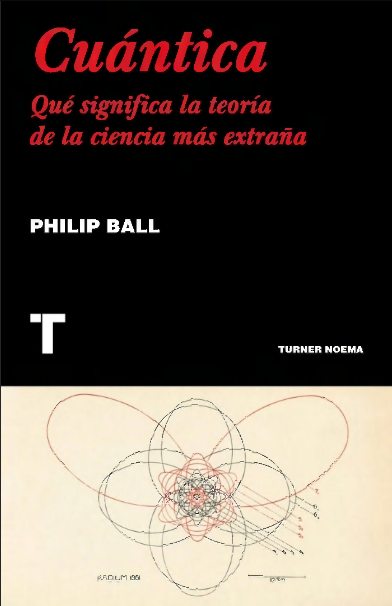
Cuántica: Qué significa la teoría de la ciencia más extraña book pdf download

Size of file : 3.04MB
Number of Pages : 50
Department : Natural Science
Section : classical physics
Date of Coming : 2022-08-10
book quality : Excellent
Language : Spanish
Auther : Philip Ball

Author: Philip Ball

About the Author: Philip Ball is a freelance science writer. He worked previously at Nature for over 20 years, first as an editor for physical sciences (for which his brief extended from biochemistry to quantum physics and materials science) and then as a Consultant Editor. His writings on science for the popular press have covered topical issues ranging from cosmology to the future of molecular biology. Philip is the author of many popular books on science, including works on the nature of water, pattern formation in the natural world, colour in art, the science of social and political philosophy, the cognition of music, and physics in Nazi Germany. He has written widely on the interactions between art and science, and has delivered lectures to scientific and general audiences at venues ranging from the Victoria and Albert Museum (London) to the NASA Ames Research Center, London’s National Theatre and the London School of Economics. Philip continues to write regularly for Nature. He has contributed to publications ranging from New Scientist to the New York Times, the Guardian, the Financial Times and New Statesman. He is a contributing editor of Prospect magazine (for which he writes a science blog), and also a columnist for Chemistry World, Nature Materials, and the Italian science magazine Sapere. He has broadcast on many occasions on radio and TV, and is a presenter of “Science Stories” on BBC Radio 4. He is a Fellow of the Royal Society of Chemistry, sits on the editorial board of Chemistry World and Interdiscipinary Science Reviews, and is a board member of the RESOLV network on solvation science at the Ruhr University of Bochum. Philip has a BA in Chemistry from the University of Oxford and a PhD in Physics from the University of Bristol. Philip Ball is a writer. Most of his books are concerned with science in some form or another: its history, its interactions with the arts and society, its achievements, delights and detours. He is a regular columnist for several magazines and an occasional radio presenter and broadcaster. He was an editor of Nature for many years, and long ago, a chemist and physicist of sorts.

Cuántica: Qué significa la teoría de la ciencia más extraña book pdf download By Philip Ball

‘If you aren’t shocked by quantum mechanics, you haven’t understood it.’ Since Niels Bohr said this many years ago, quantum mechanics has only been getting more shocking. We now realise that it’s not just telling us that ‘weird’ things happen out of sight, on the tiniest level, in the atomic world. It tells us that everything is quantum: our everyday world is simply what quantum becomes at the human scale. But if quantum mechanics is right, what seems obvious and right in our everyday world is built on foundations that don’t seems obvious or right, or even possible, at all. Over the past decade or so theories and experiments have called into question the meanings and limits of space and time, cause and effect, and knowledge itself. Yet calling the quantum world ‘weird’ – implying that it’s weird down there but we’re OK up here – won’t do any longer. The quantum world isn’t a different world: it is our world, and if anything deserves to be called ‘weird’, it’s us. Beyond Weird offers the first up-to-date, accessible account of the quest to get to grips with the most fundamental theory of physical reality, and to explain how its counterintuitive principles create the world we experience.

Download PDF of Cuántica: Qué significa la teoría de la ciencia más extraña book pdf download By Philip Ball
-Adrian Agency Library

Download Now

Four Laws That Drive the Universe book pdf download

Date of Coming : 2022-08-10
Auther : Peter William Atkins
Section : classical physics
Language : English
Department : Natural Science
Size of file : 1.50MB
Number of Pages : 142
book quality : Excellent

Author: Peter William Atkins

About the Author: Peter William Atkins (born 10 August 1940) is an English chemist and former Professor of Chemistry at the University of Oxford and a Fellow of Lincoln College. He is a prolific writer of popular chemistry textbooks, including Physical Chemistry, Inorganic Chemistry, and Molecular Quantum Mechanics.

Four Laws That Drive the Universe book pdf download By Peter William Atkins

The laws of thermodynamics drive everything that happens in the universe. From the sudden expansion of a cloud of gas to the cooling of hot metal, and from the unfurling of a leaf to the course of life itself–everything is moved or restrained by four simple laws. They establish fundamental concepts such as temperature and heat, and reveal the arrow of time and even the nature of energy itself. Written by Peter Atkins, one of the worlds leading authorities on thermodynamics, this powerful and compact introduction explains what these four laws are and how they work, using accessible language and virtually no mathematics. Guiding the reader a step at a time, Atkins begins with Zeroth (so named because the first two laws were well established before scientists realized that a third law, relating to temperature, should precede them–hence the jocular name zeroth), and proceeds through the First, Second, and Third Laws, offering a clear account of concepts such as the availability of work and the conservation of energy. Atkins ranges from the fascinating theory of entropy (revealing how its unstoppable rise constitutes the engine of the universe), through the concept of free energy, and to the brink, and then beyond the brink, of absolute zero. C.P. Snow once remarked that not knowing the second law of thermodynamics is like never having read a work by Shakespeare. This brief but brilliant book introduces general readers to one of the cornerstones of modern science, four laws that are as integral to the well-educated mind as such great dramatic works as Hamlet or Macbeth.

Download PDF of Four Laws That Drive the Universe book pdf download By Peter William Atkins
-Adrian Agency Library

Download Now

the Laws of Thermodynamics: A Very Short Introduction book pdf download

Language : English
Auther : Peter William Atkins
Section : classical physics
Department : Natural Science
book quality : Excellent
Size of file : 0.83MB
Number of Pages : 123
Date of Coming : 2022-08-10

Author: Peter William Atkins

About the Author: Peter William Atkins (born 10 August 1940) is an English chemist and former Professor of Chemistry at the University of Oxford and a Fellow of Lincoln College. He is a prolific writer of popular chemistry textbooks, including Physical Chemistry, Inorganic Chemistry, and Molecular Quantum Mechanics.

the Laws of Thermodynamics: A Very Short Introduction book pdf download By Peter William Atkins

The laws of thermodynamics drive everything that happens in the universe. From the sudden expansion of a cloud of gas to the cooling of hot metal–everything is moved or restrained by four simple laws. Written by Peter Atkins, one of the world’s leading authorities on thermodynamics, this powerful and compact introduction explains what these four laws are and how they work, using accessible language and virtually no mathematics. Guiding the reader a step at a time, Atkins begins with Zeroth (so named because the first two laws were well established before scientists realized that a third law, relating to temperature, should precede them–hence the jocular name zeroth), and proceeds through the First, Second, and Third Laws, offering a clear account of concepts such as the availability of work and the conservation of energy. Atkins ranges from the fascinating theory of entropy (revealing how its unstoppable rise constitutes the engine of the universe), through the concept of free energy, and to the brink, and then beyond the brink, of absolute zero.About the Series: Combining authority with wit, accessibility, and style, Very Short Introductions offer an introduction to some of life’s most interesting topics. Written by experts for the newcomer, they demonstrate the finest contemporary thinking about the central problems and issues in hundreds of key topics, from philosophy to Freud, quantum theory to Islam.

Download PDF of the Laws of Thermodynamics: A Very Short Introduction book pdf download By Peter William Atkins
-Adrian Agency Library

Download Now

Il secondo principio book pdf download

book quality : Excellent
Number of Pages : 232
Auther : Peter William Atkins
Language : Italian
Date of Coming : 2022-08-10
Section : classical physics
Size of file : 56.2MB
Department : Natural Science

Author: Peter William Atkins

About the Author: Peter William Atkins (born 10 August 1940) is an English chemist and former Professor of Chemistry at the University of Oxford and a Fellow of Lincoln College. He is a prolific writer of popular chemistry textbooks, including Physical Chemistry, Inorganic Chemistry, and Molecular Quantum Mechanics.

Il secondo principio book pdf download By Peter William Atkins

Il secondo principio

Download PDF of Il secondo principio book pdf download By Peter William Atkins
-Adrian Agency Library

Download Now

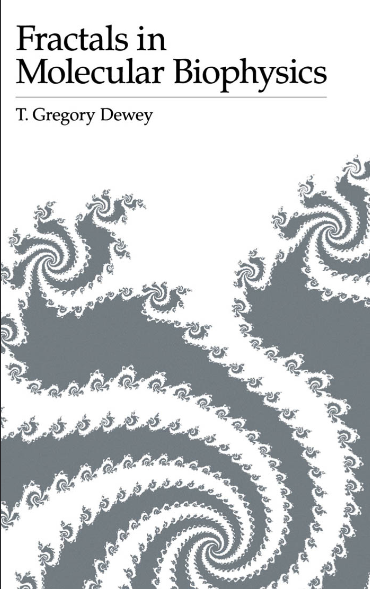
Fractals in Molecular Biophysics book pdf download

Size of file : 14.5MB
Auther : Gregory Dewey
Date of Coming : 2022-08-25
Department : Natural Science
Number of Pages : 289
book quality : Excellent
Language : English
Section : classical physics

Author: Gregory Dewey

About the Author: Gregory Dewey, Ph.D., has been named President of Albany College of Pharmacy and Health Sciences. The Board of Trustees of Albany College of Pharmacy and Health Sciences has selected Gregory Dewey, Ph.D., to be the College’s next president. When he assumes his new role on July 1, 2014, Dr. Dewey will become just the eighth president in the school’s 132-year history.
Dr. Dewey currently serves as Provost at the University of La Verne in California, a role he has held since 2009. In that capacity, he has been responsible for achieving the highest standards of academic excellence, ensuring outstanding teaching and promoting scholarly and creative activities. During his time at La Verne, he has overseen academic affairs, student affairs, student services, enrollment management, financial aid, and athletics for the institution. The University of La Verne is a comprehensive doctoral university that enrolls approximately 8,000 students over four colleges and nine regional campuses.

Fractals in Molecular Biophysics book pdf download By Gregory Dewey

Historically, science has sought to reduce complex problems to their simplest components, but more recently it has recognized the merit of studying complex phenomena in situ. Fractal geometry is one such appealing approach, and this book discusses its application to complex problems in molecular biophysics. The book provides a detailed, unified treatment of fractal aspects of protein and structure dynamics, fractal reaction kinetics in biochemical systems, sequence correlations in DNA and proteins, and descriptors of chaos in enzymatic systems. In an area that has been slow to acknowledge the use of fractals, this is an important addition to the literature, offering a glimpse of the wealth of possible applications to complex problems.

Download PDF of Fractals in Molecular Biophysics book pdf download By Gregory Dewey
-Adrian Agency Library

Download Now

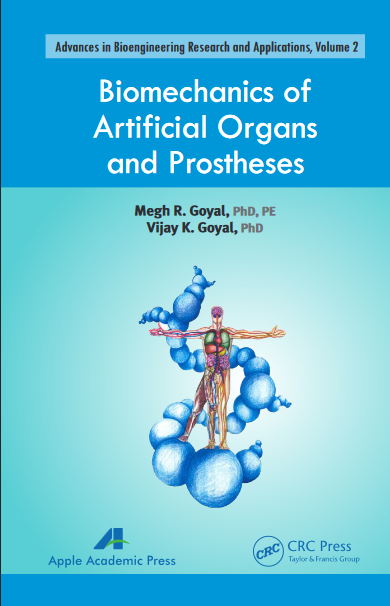
Biomechanics of Artificial Organs and Prostheses book pdf download

Auther : Megh Goyal
Department : Natural Science
Section : classical physics
Date of Coming : 2022-08-26
Size of file : 12.0MB
book quality : Excellent
Number of Pages : 618
Language : English

Author: Megh Goyal

About the Author: Megh Goyal is an engineer and professor in Puerto Rico, and a Methodist pastor. He has been called the father of irrigation engineering in Puerto Rico.Goyal earned his high school diploma from Prem Sabha High School in Sangrur; B.Sc. degree in Agricultural Engineering from Punjab Agricultural University, Ludhiana – India; M.Sc. degree (1977) and Ph.D. (1979) from Ohio State University, Columbus, Ohio; and Master of Divinity (2001) from Puerto Rico Evangelical Seminary, Hato Rey – Puerto Rico.
Goyal has worked as a soil conservation inspector, research assistant and lecturer at Haryana Agricultural University, research associate at the Ohio State University, and research agricultural engineer at the Agricultural Experiment Station of University of Puerto Rico – Mayaguez Campus. He was the first agricultural engineer to receive a professional license in agricultural engineering in 1971, from the Institution of Engineers (India), and in 1986, from College of Engineers & Surveyors of Puerto Rico. For his pioneering work on micro-irrigation, he is known as a “Drip Irrigation Man” in Puerto Rico.
Goyal is currently a retired professor of agricultural engineering and biomedical engineering at the College of Engineering of the University of Puerto Rico
Goyal has authored journal articles and text books such as: “Introduction to Agriclimatology”, Management of Drip/trickle or Micro Irrigation, and Biofluid Dynamics of Human Body Systems
On 16 September 2005, Goyal was named “Father of Irrigation Engineering in Puerto Rico for the 20th Century” by the ASABE – Puerto Rico Section, for his pioneer work on irrigation,evapotranspiration, climatology, and soil and water engineering.

Biomechanics of Artificial Organs and Prostheses book pdf download By Megh Goyal

Artificial organs are one of the world’s greatest advancements in medicine. This book covers cardiopulmonary bypass surgery; artificial hearts and pacemakers; stenting and ballooning; artificial lungs, kidneys, and knees, dental protheses; and more. It is a one-stop source of basic knowledge and techniques necessary to understand, design, develop, and evaluate artificial organs and prostheses. It covers the basic principles and applications, types and mechanics, and biomaterials. It is a must for physicians, scientists, and educators.

Download PDF of Biomechanics of Artificial Organs and Prostheses book pdf download By Megh Goyal
-Adrian Agency Library

Download Now