
| Number of Pages | : 850 |
| book quality | : Excellent |
| Date of Coming | : 2022-08-10 |
| Size of file | : 3.66MB |
| Department | : literature |
| Auther | : Naguib Mahfouz |
| Language | : English |
| Section | : Historical novels |
Author: Naguib Mahfouz
About the Author: Naguib Mahfouz: The pioneer of the Arabic novel, and the winner of the highest literary prize in the world.
He was born on December 11, 1911 in Al-Gamaliya neighborhood in Cairo, to a middle-class family. His father was a government employee. He chose the name of the doctor who supervised his birth, Dr. Naguib Mahfouz Pasha, so that his name would be compounded by Naguib Mahfouz.
He was sent to writers at a young age, and then enrolled in primary school, during which he learned about the adventures of “Ben Johnson”, which he borrowed from a colleague to read, to be Mahfouz’s first experience in the world of reading. He also experienced the 1919 revolution at the age of eight, and it left a profound impact on him that later appeared in his novels.
After high school, Mahfouz decided to study philosophy and joined the Egyptian University, and there he met the Dean of Arabic Literature, Taha Hussein, to tell him of his desire to study the origin of existence. At this stage, his passion for reading increased, and he was preoccupied with the ideas of philosophers, which had the greatest impact on his way of thinking.
After graduating from the university, he worked as an administrative employee there for a year, then held several government jobs such as his work as a secretary in the Ministry of Awqaf. He also held several other positions, including: Head of the Oversight Authority at the Ministry of Guidance, Chairman of the Board of Directors of the Cinema Support Foundation, and Adviser to the Ministry of Culture.
Mahfouz had intended to complete academic studies and prepare for a master’s degree in philosophy on the subject of “Beauty in Islamic Philosophy,” but he fought a struggle with himself between his love for philosophy on the one hand, and his love for tales and literature, which began from his childhood on the other, and ended this internal conflict in favor of literature; He saw that philosophy could be presented through literature.
Mahfouz began to feel his first steps in the world of literature by writing stories, so he published eighty stories without payment. In 1939, his first creative experiments came to light. The novel “The Abatement of Destinies”, after which he continued writing the novel and the short story in addition to the play, as well as press articles and scenarios for some Egyptian films.
Mahfouz’s novelist experience went through several stages, starting with the historical stage in which he returned to ancient Egyptian history, and issued his three historical trilogy: “The Absurdity of Predestination,” “Radopis,” and “The Good Struggle.” Then the realistic stage that began in 1945 AD, coinciding with the Second World War; At this stage, he approached reality and society, and published his realistic novels such as “New Cairo” and “Khan Al-Khalili”, reaching the peak of novelistic creativity with the famous trilogy: “Bain Al Qasrain”, “Qasr Al-Shouq” and “Al-Sukaria”. Then the symbolic or intellectual stage, whose most prominent works were: “The Road”, “The Beggar”, “Gossip over the Nile”, and “The Children of Our Neighborhood” (which caused widespread controversy in religious circles, and its publication was banned for a while).
In 1994, Mahfouz was subjected to an assassination attempt, from which he survived, but it affected the nerves of the upper right side of the neck, negatively affecting his ability to write.
He received many international and local awards, most notably: the “Nobel Prize in Literature” in 1988, and the “Nile Necklace” in the same year.
The icon of Egyptian and Arabic literature “Naguib Mahfouz” passed away on August 30, 2006 AD, after a life full of creativity and giving, during which he presented many literary works close to humans and loaded with the philosophy of life, which is a great legacy that every Egyptian, every Arab, and every human celebrates.
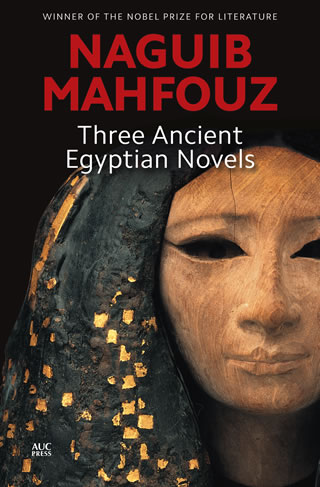
Three Novels of Ancient book pdf download By Naguib Mahfouz
This paperback compendium edition combines Naguib Mahfouz’s first three novels, all set in ancient Egypt, which skillfully explore recurring themes within human relationships: the balance between destiny and individual agency, the sanctity of the bonds to the land and religion, and the constant power struggles that affect human lives at multiple levels. In Khufu’s Wisdom, translated by Raymond Stock, Pharaoh Khufu is battling the Fates. At stake is the inheritance of Egypt’s throne, the proud but tender heart of Khufu’s beautiful daughter Princess Meresankh, and Khufu’s legacy as a sage, not savage, ruler. Rhadopis of Nubia, translated by Anthony Calderbank, follows the powerful love that grows between Rhadopis, a courtesan whose ravishing beauty is unmatched in time or place, and youthful, headstrong Pharaoh Merenra, worshiped by his people as a divine presence on earth, against the background of the high politics of Sixth Dynasty Egypt. Finally, in Thebes at War, translated by Humphrey Davies and written in 1937–1938 when Britain and Turkey held sway over Egypt, Mahfouz dramatically depicts the Egyptian people’s undying loyalty to their land and religion and their refusal to bow to outside domination. After two hundred years of occupation, the Hyksos leader in his capital in northern Egypt tells Pharaoh in the south that the roaring of the sacred hippopotami at Thebes is keeping him awake at night and demands that they be killed, galvanizing Egypt into hurling its armies into a struggle to drive the barbarians from its sacred soil forever.
Download PDF of Three Novels of Ancient book pdf download By Naguib Mahfouz
-Adrian Agency Library

No comment yet, add your voice below!